
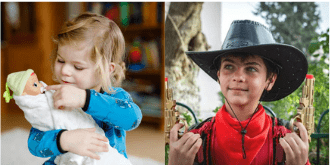
Girls like dolls, boys like guns! – How society limits our children’s potential.
How can we make sure that our children grow up in a more flexible world and one where females globally are recognised for the individuals they are? The simplistic answer is to avoid gender stereotypes in how we interact with our children, the books we give them to read and the toys we give them to play with. Implementation is a little trickier with many family members, teachers and advertisers consciously and subconsciously reinforcing the gender stereotypes that they grew up with.
Looking at toys. Girls get dolls and kitchens, reinforcing the idea of nurturing; boys get guns and vehicles that tends to reinforce the idea of competitiveness. The consequences of gendered play where pre-conceived expectations are enforced on the child often has a major impact on their development. Boys can feel pressured to hide their emotions and empathy, whereas girls may seek to avoid competitive activities such as sports or STEM subjects, even if they have a natural inclination and talent for them. This can result in boys steering away from and never learning how to manage vulnerable emotional situations, whilst girls don’t get to develop leadership, problem solving or analytical skills. These traits persist to influence decisions made as adults. Hence, we see women underrepresented in science and engineering careers and top leadership positions, yet they are overrepresented in caring careers and lower level jobs.
For those who like to read, books that showcase women in non-traditional roles or that laud their achievements are only just starting to emerge. Women have always been amazing, but their achievements were not included when the history books were written (by men). So, you get to know that Marco Polo was an intrepid explorer, but do you don’t get to hear about the explorer and botanist Jeanne Baret who was the first women to circumnavigate the earth on a ship in 1767. She had to do so disguised as a man as the French Navy did not allow women on board. We know that Alexander Fleming discovered penicillin, but far fewer people will have heard of Gerty Cori whose research led to diabetes treatments and a Nobel prize in 1947? How about Shannon Lucid who spent her whole life fighting the system before finally making it into space (and who has now spent more hours in space than any American to date). Compare that to Neil Armstrong’s career path.
Moving Forward
Teachers and parents have an important role to play in expanding children’s perspectives. By modeling inclusive behaviors and encouraging all children to participate in activities without gender biases, adults can help dismantle harmful stereotypes. For instance, a boy interested in ballet or dolls, or a girl who wants to play football or who loves coding should be met with support, not ridicule or discouragement. Exposing children to diverse role models and experiences helps broaden their worldview and allows them to envision themselves in a variety of future roles, whether that’s a scientist, a teacher, an entrepreneur, or an artist. In this aspect, books are an excellent resource and we have a huge range of fiction and non-fiction available that celebrates both women and men who have broken with traditional stereotyping, as well as relatable stories of children happily and productively engaging in non-stereotypical activities. As a parent, grandparent, carer or teacher, we will not always get it right – but we can aim to do our best. Book & Toy’s mission is to acompany you on that journey, selecting only the best book titles and toys that positively contribute to your child’s development.
